Quantifying representational mismatch between narratives and structured reports in near-death experiences

Narratives and questionnaires do not describe the same experience in the same way.

Cristian Pulido · Francisco Gómez · Prejaas K.B. Tewarie · Roxane S. Hoyer · Steven Laureys

The Problem

Two valid views of the same NDE can diverge: narratives preserve local events and ambiguity, while questionnaires provide global retrospective summaries.

Core Idea

  • Narratives preserve temporal and local signals, including ambiguity and distress.
  • Questionnaires compress experience into standardized global categories.
  • Both are informative, but they are not equivalent representations.
  • The contribution is to measure this mismatch as a structured pattern.

Abstract

  • Alignment is partial: experiential NDE-C is more recoverable than reflective NDE-MCQ.
  • Narrative tone is informative, but not a reliable proxy for global self-reported valence.
  • Strong benchmark performance supports a representational gap, not only model limitation.

Example 1 · Local worry

"It was very bright... I was worried because I wanted to go downstairs and wake up, but I couldn't."

A globally positive report can still include locally distressing narrative segments.

Example 2 · Ambiguous language

"monochrome beige fixed image, in an attic, mushroom and wooden case. Don't calm down."

Fragmented expression weakens alignment between text tone and questionnaire labels.

Example 3 · Muted expression

"No pain, no voice, no reaction, total nothing."

Low-affect wording can appear neutral despite a positive retrospective appraisal.

Glossary

Pipeline / Method

01 Narrative input icon

Narrative

Sectioned first-person reports

02 Segmentation icon

Segmentation

Validate and reassign text blocks

03 Extraction icon

Extraction

LLM and lexical signal parsing

04 Alignment icon

Alignment

Compare against questionnaire labels

05 Interpretation icon

Interpretation

Quantify representational mismatch

Key Results

149

Structured narratives analyzed

kappa ~0.37

NDE-C alignment region

kappa ~0.11

NDE-MCQ alignment region

What Mismatch Is Not

  • It is not random noise.
  • It is not only model failure.
  • It does not invalidate narrative reports.

Two Representational Layers

  • Narrative layer: local episodes, sequence, ambiguity, mixed tone.
  • Questionnaire layer: global summary, predefined options, retrospective appraisal.
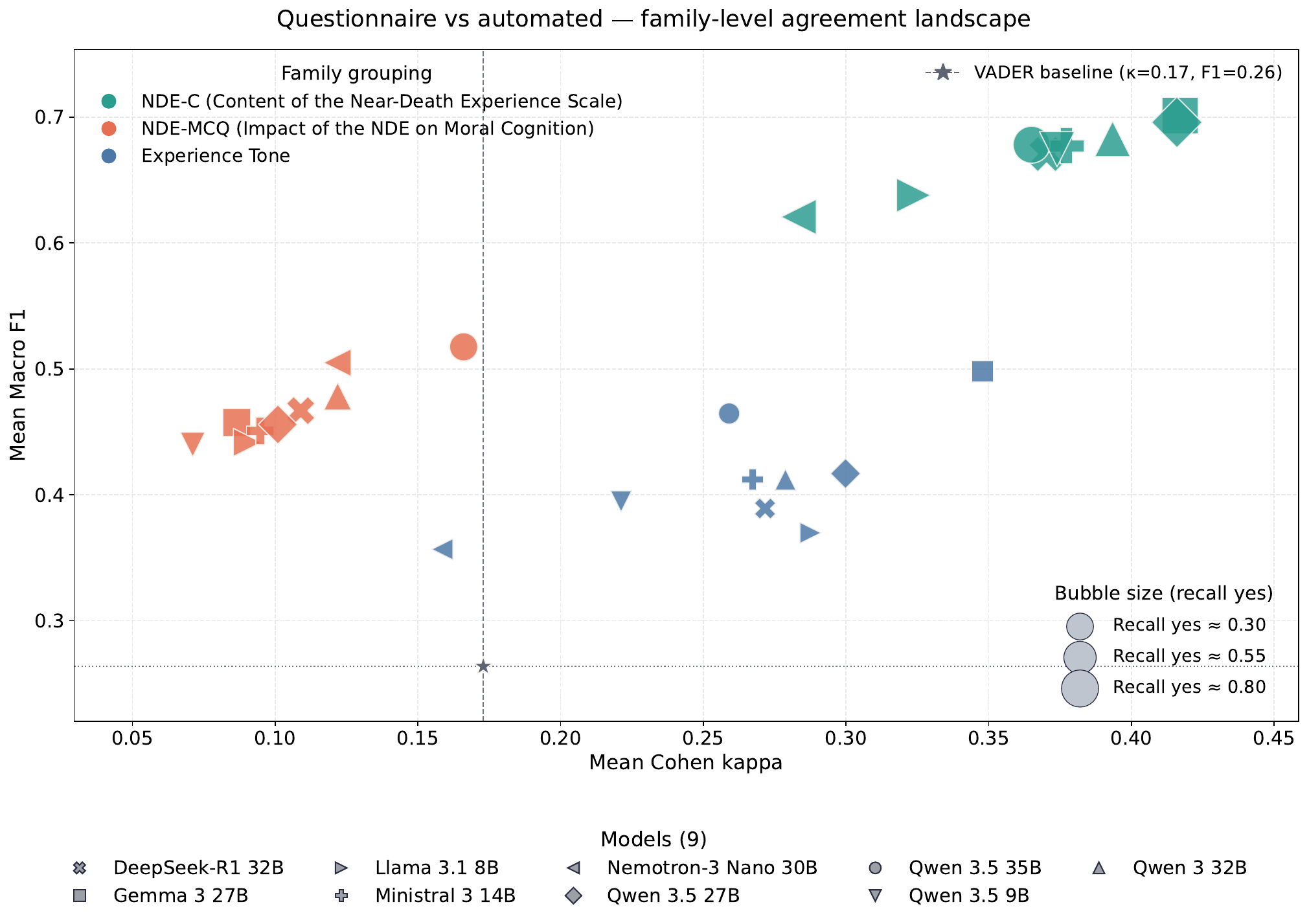
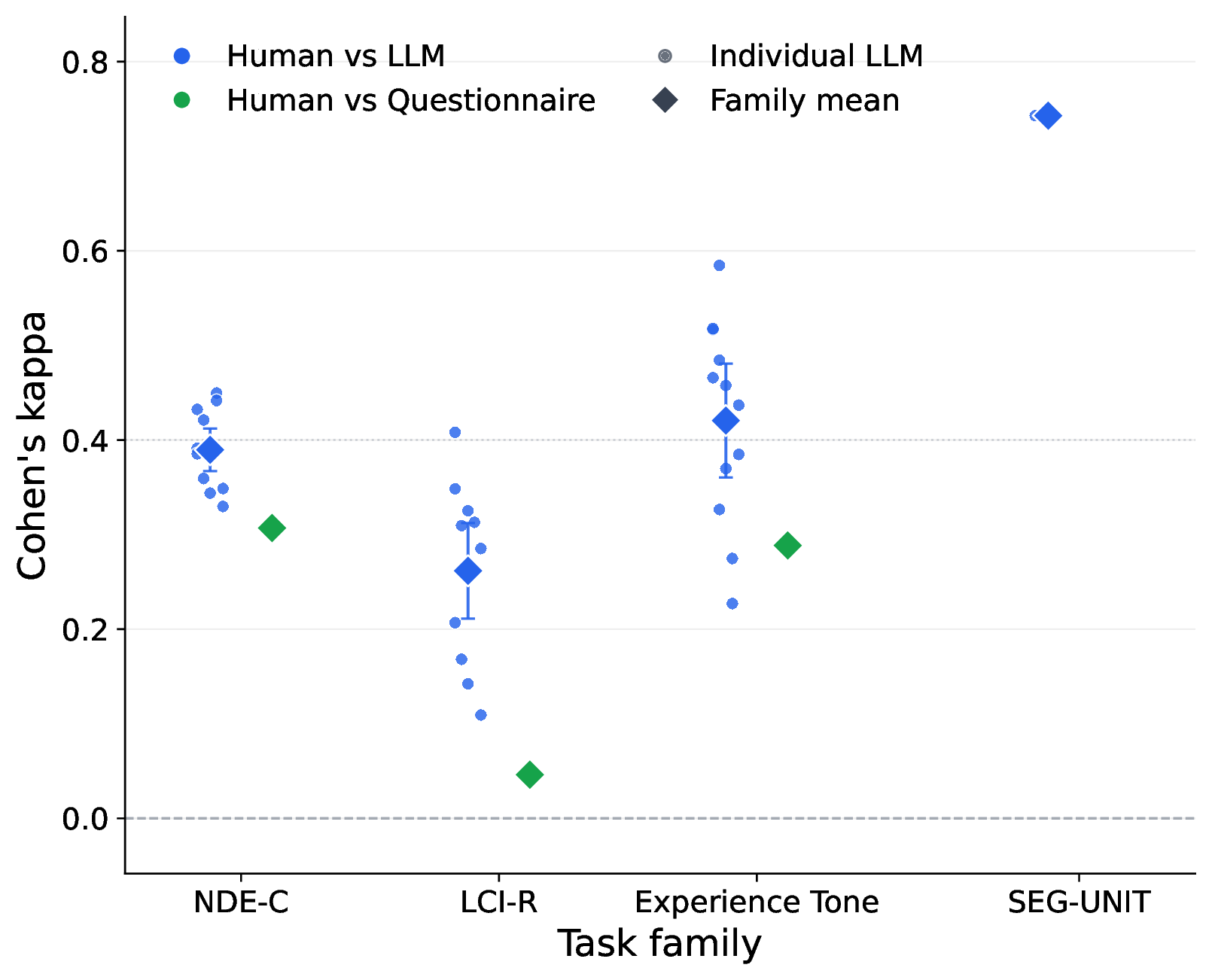
Family-level agreement landscape with stronger NDE-C alignment and weaker NDE-MCQ alignment

Family-Level Mismatch Pattern

Alignment is not uniform: NDE-C features cluster high, tone is intermediate, and NDE-MCQ after-effects remain low.

How to read: upper-right means stronger alignment between text-derived outputs and questionnaire labels.

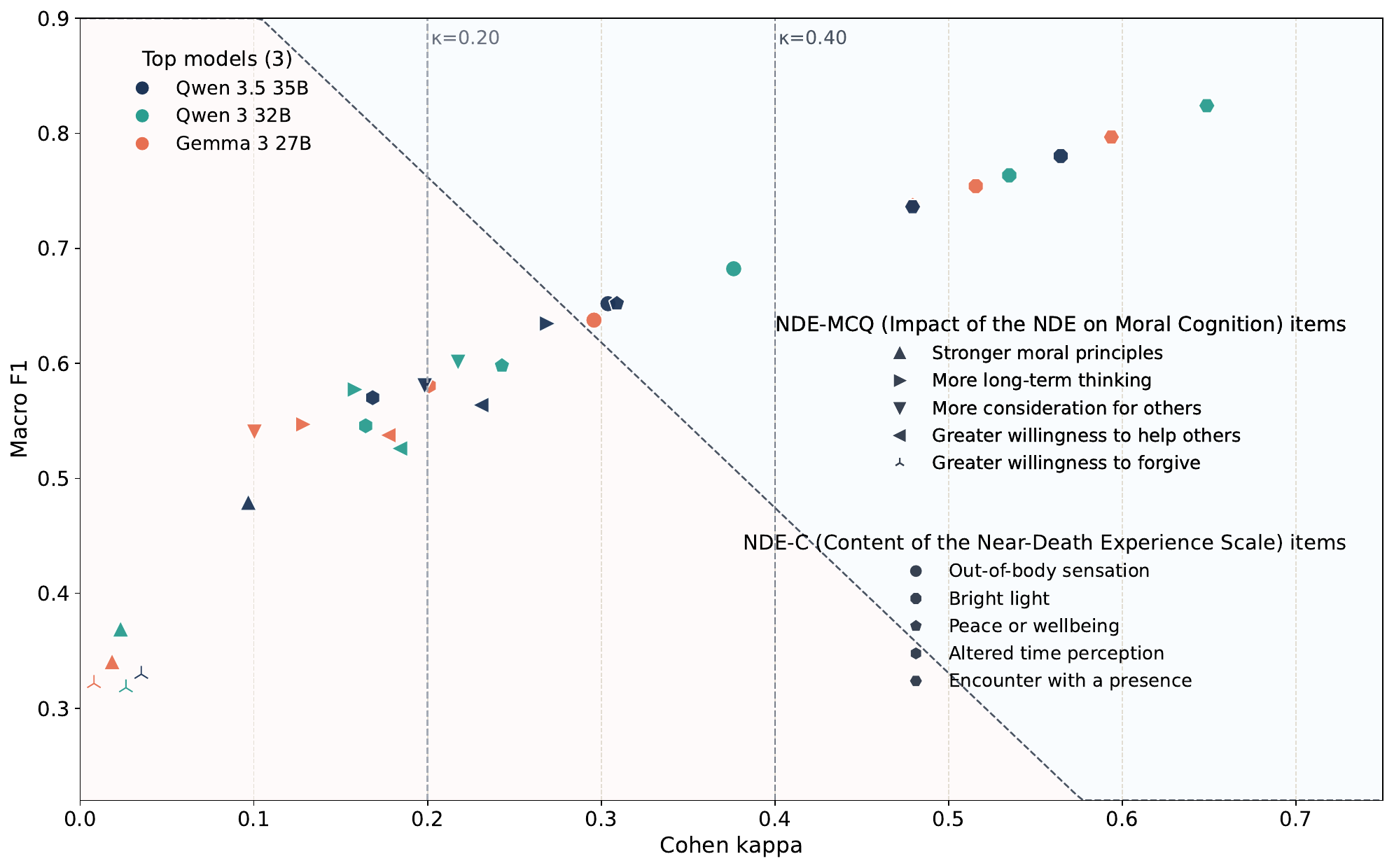
Item-level scatter where experiential features show higher agreement than reflective after-effects

Concrete Features Are More Recoverable

Perceptual experience items are extracted more reliably than reflective change items, indicating different linguistic recoverability.

How to read: circles trend higher than triangles, indicating stronger recoverability of phenomenological content.

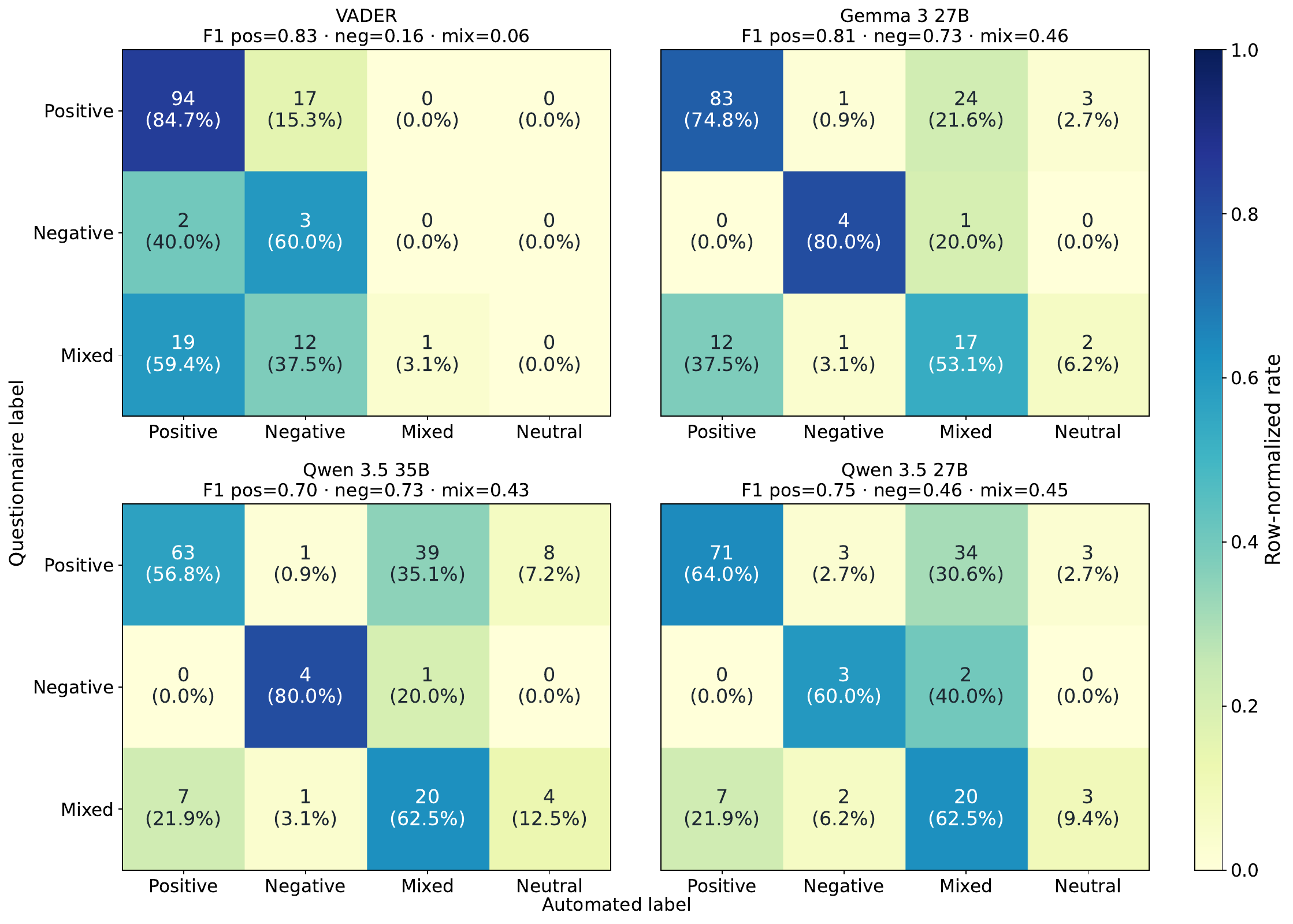
Confusion matrix showing most disagreement in mixed and neutral categories

Tone Is Informative, But Not Equivalent to Valence

Disagreement concentrates around mixed and neutral regions instead of direct positive-negative reversals.

How to read: disagreement clusters near ambiguous categories rather than polarity flips.

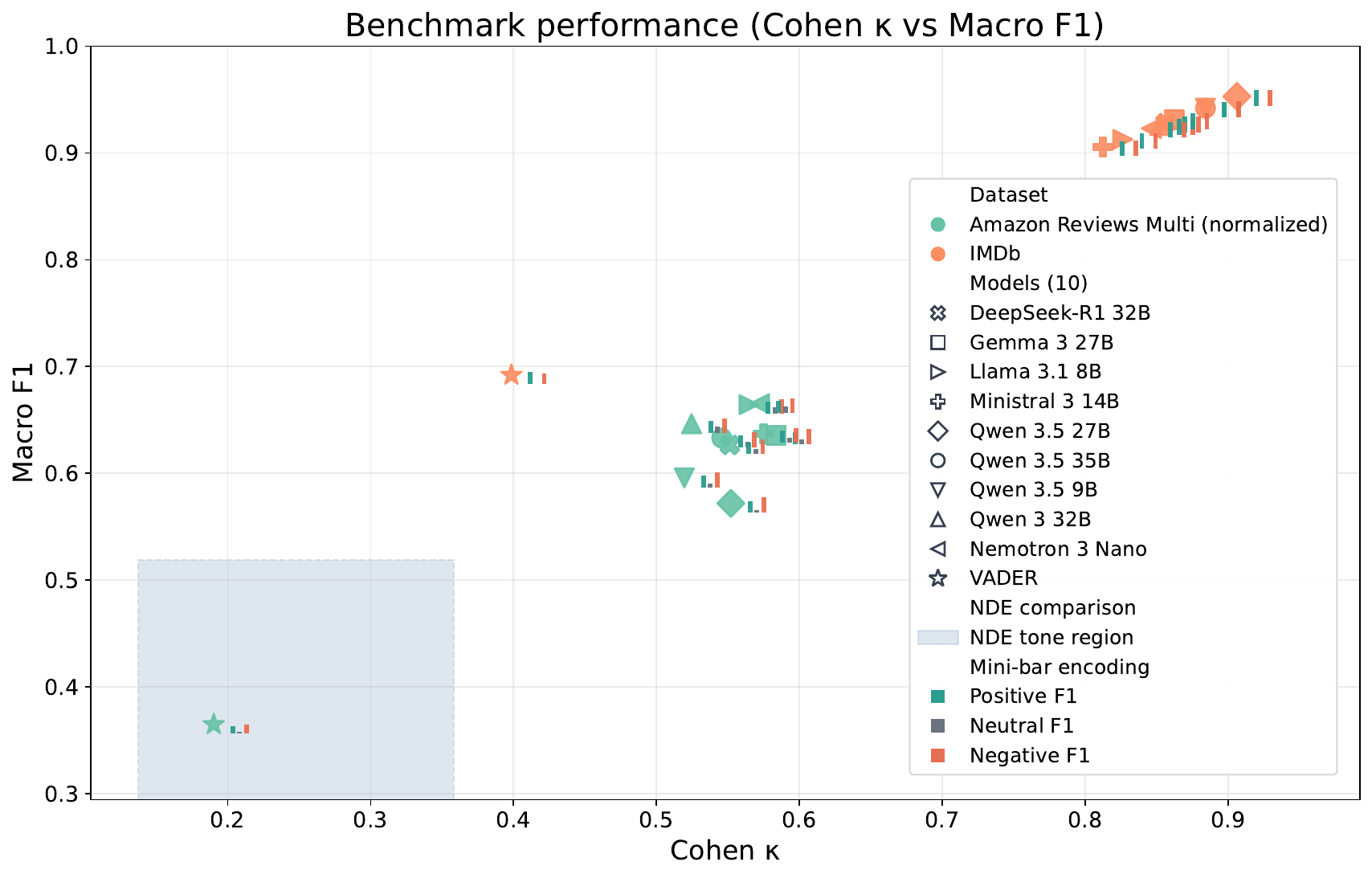
Benchmark chart showing stronger text-label alignment outside the NDE domain

Benchmark Gap Supports the Main Claim

Higher agreement on standard sentiment datasets shows the NDE gap is mainly representational, not just model failure.

How to read: benchmark points occupy higher agreement regions than NDE tone results.

Interactive Demo

Try the interactive demo to explore narrative sections, extraction outputs, and alignment behavior.

Open Demo in New Tab

Video Overview

A short visual summary of findings and framing.

Authors & Affiliations

Authors

  • Cristian Pulido (1, 2)
  • Francisco Gómez (1)
  • Prejaas K.B. Tewarie (2, 3)
  • Roxane S. Hoyer (2)
  • Steven Laureys (2, 4)

Institutions

  1. Universidad Nacional de Colombia, Bogota, Colombia
  2. Joint International Research Unit on Neuroplasticity, CERVO Brain Research Center, Universite Laval, Quebec City, Canada
  3. Sir Peter Mansfield Imaging Center, School of Physics, University of Nottingham, Nottingham, United Kingdom
  4. Coma Science Group, GIGA-Consciousness, University of Liege, Liege, Belgium

Equal contribution: Roxane S. Hoyer and Steven Laureys.

BibTeX

@article{pulido2026stories2structure,
  title   = {Quantifying representational mismatch between narratives and structured reports in near-death experiences},
  author  = {Pulido, Cristian and Gomez, Francisco and Tewarie, Prejaas K.B. and Hoyer, Roxane S. and Laureys, Steven},
  journal = {Consciousness and Cognition},
  year    = {2026},
  note    = {Preprint / under review}
}