
 PhD Student in Systems and Computer Engineering
 Visiting Ph.D. Research Intern at Université Laval / CERVO
 Data Science Researcher
I am a mathematician with a strong background in applied modeling and computational analysis. My current work focuses on the integration of uncertainty-aware predictive models into decision-making processes for complex systems.
Through my doctoral research, I focus on integrating uncertainty into predictive models to improve decision-making in emergency response systems. I study how incomplete information and intervention-induced behavioral changes affect planning and resource allocation. At DataLab, I contribute to the development of data-driven tools for assessing health risks, optimizing interventions, and supporting public sector decision-making.
Security & Crime Prediction · Animal Health & Epidemiology · Decision Support Systems · Network Modeling
Warning
Problem: The current name of your GitHub Pages repository ("Solution: Please consider renaming the repository to "
http://".
However, if the current repository name is intended, you can ignore this message by removing "{% include widgets/debug_repo_name.html %}" in index.html.
Action required
Problem: The current root path of this site is "baseurl ("_config.yml.
Solution: Please set the
baseurl in _config.yml to "Education
-
Universidad Nacional de Colombia, Bogotá D.C., Colombia.Department of Systems and Industrial Engineering
Ph.D. StudentAug. 2023 - present -
Université Laval (Quebec, Canada) / CERVO Research CentreVisiting Ph.D. Research Intern (ELAP Mobility Stay)Jan. 12, 2026 – May 7, 2026
-
Universidad Nacional de Colombia, Bogotá D.C., Colombia.Department of Mathematics
M.Sc. in Applied MathematicsFeb. 2018 - Nov. 2020 -
 Universidad Distrital Francisco José de Caldas, Bogotá D.C., Colombia.Faculty of Science and Education
B.Sc. in MathematicsFeb. 2011 – Apr. 2017
Experience
-
DataLab – Universidad Nacional de ColombiaResearcher in Predictive AnalyticsDec. 2019 – Present
-
 Universidad Antonio Nariño (UAN)Adjunct Professor (Lecturer 2022–2024, Adjunct from 2024)Feb. 2022 – Dec. 2025
 -
 ViveLab BogotáResearcher in Emerging TechnologiesJun. 2019 – Sep. 2019
 -
 Fundación Universitaria de Ciencias de la SaludResearch Assistant – Medical ImagingMar. 2018 – Nov. 2019
Honors & Awards
-
Best Student Paper Award - 7th Int. Conference on Behavioral and Social Computing (BESC)2020
-
Emerging Leaders in the Americas Program (ELAP) Scholarship – Government of Canada. Selected for the ELAP scholarship funded by Global Affairs Canada to carry out a 4-month doctoral research stay at Université Laval (Quebec, Canada) from Jan. 12, 2026 to May 7, 2026.2025
Selected Publications (view all )

Quantifying Predictive Uncertainty in Crime Forecasting using Conformal Prediction
Cristian Pulido, Francisco Gómez
Accepted at 19° Congreso Colombiano de Computación (CCCesp 2025) SecurityUncertainty
This work presents a model-agnostic framework using Conformal Prediction to generate calibrated prediction intervals for crime hotspot forecasting. Applied to Chicago data, it reveals spatial variations in prediction confidence, highlighting the value of uncertainty in decision-making.
Quantifying Predictive Uncertainty in Crime Forecasting using Conformal Prediction
Cristian Pulido, Francisco Gómez
Accepted at 19° Congreso Colombiano de Computación (CCCesp 2025) SecurityUncertainty
This work presents a model-agnostic framework using Conformal Prediction to generate calibrated prediction intervals for crime hotspot forecasting. Applied to Chicago data, it reveals spatial variations in prediction confidence, highlighting the value of uncertainty in decision-making.
A Question-Driven AI Framework for Early-Stage Territorial Decision Support
Cristian Pulido*, Oscar Sánchez*, Diana Aldana, Juan Diego Murcia, Sarah Coral, Francisco Gómez (* equal contribution)
Accepted at 19° Congreso Colombiano de Computación (CCCesp 2025) Spotlight Decision Support
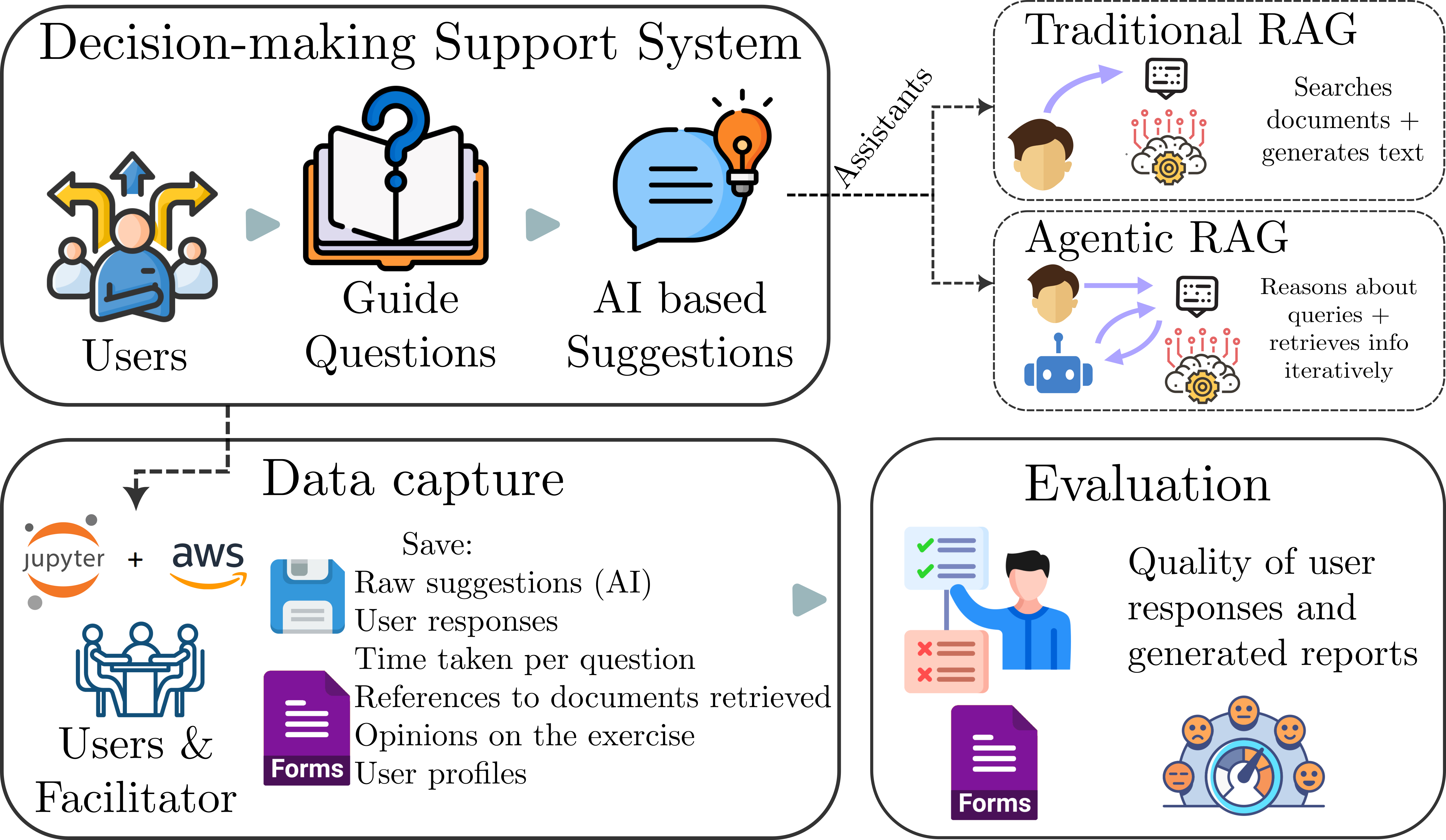
This work introduces a modular AI framework combining guiding questions with LLM-based assistants to support early-stage territorial planning in Colombia. Two assistants—traditional RAG and agentic RAG—were evaluated, showing improved response quality and usefulness.
A Question-Driven AI Framework for Early-Stage Territorial Decision Support
Cristian Pulido*, Oscar Sánchez*, Diana Aldana, Juan Diego Murcia, Sarah Coral, Francisco Gómez (* equal contribution)
Accepted at 19° Congreso Colombiano de Computación (CCCesp 2025) Spotlight Decision Support
This work introduces a modular AI framework combining guiding questions with LLM-based assistants to support early-stage territorial planning in Colombia. Two assistants—traditional RAG and agentic RAG—were evaluated, showing improved response quality and usefulness.
Quantifying perception of security through social media and its relationship with crime
Luisa Fernanda Chaparro, Cristian Pulido, Jorge Rudas, Jorge Victorino, Ana María Reyes, Camilo Estrada, Luz Ángela Narváez, Francisco Gómez
IEEE Access 2021 Social Sensing
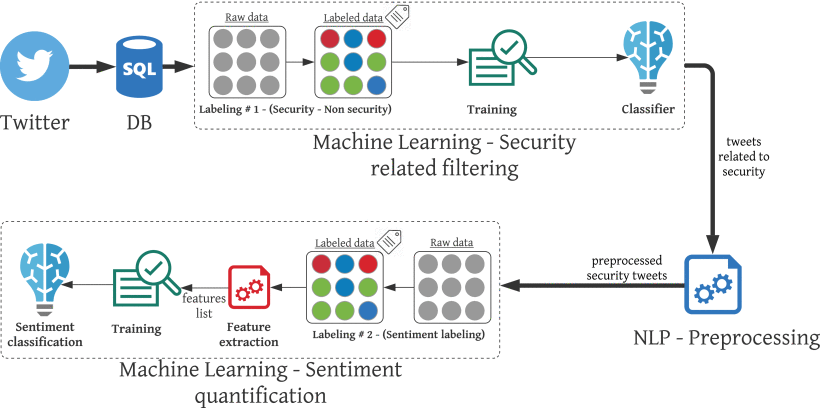
This study proposes a machine learning model to quantify the Perception of Security on Twitter using sentiment analysis and crime-related filtering. Results reveal meaningful distinctions from traditional content-counting methods and dynamic links with specific crimes like robbery.
Quantifying perception of security through social media and its relationship with crime
Luisa Fernanda Chaparro, Cristian Pulido, Jorge Rudas, Jorge Victorino, Ana María Reyes, Camilo Estrada, Luz Ángela Narváez, Francisco Gómez
IEEE Access 2021 Social Sensing
This study proposes a machine learning model to quantify the Perception of Security on Twitter using sentiment analysis and crime-related filtering. Results reveal meaningful distinctions from traditional content-counting methods and dynamic links with specific crimes like robbery.